
The global beauty device industry has grown rapidly over the past decade as consumers increasingly seek advanced skincare solutions they can use at home. Technologies such as radio frequency skin tightening, EMS facial toning, LED light therapy, and IPL hair removal are now widely available in consumer products. As a result, many beauty brands, distributors, and retailers are entering the home beauty device market.
However, before selling beauty devices in major international markets, particularly Europe and the United States, companies must comply with strict regulatory requirements. These regulations ensure that electronic beauty devices meet safety, performance, and environmental standards before reaching consumers.
For manufacturers and brands planning to expand internationally, understanding certification requirements is essential. This article explains the key certifications required to sell beauty devices in Europe and the US, how these certifications work, and why regulatory compliance is crucial for long-term success.
Why Certification Matters for Beauty Devices
Beauty devices interact directly with the skin and often use energy-based technologies such as heat, light, or electrical stimulation. Because of this, regulators classify many of these products as controlled electronic or medical-related devices.
Certification ensures that these products meet important safety and quality standards before entering the market.
Without proper certification, companies may face several problems.
Products may be blocked from entering certain markets.
Retail platforms may refuse to sell uncertified devices.
Authorities may impose fines or product recalls.
Brand reputation may suffer due to safety concerns.
For companies targeting Europe and the US, certification is not simply a legal requirement; it is also an important indicator of product reliability and consumer trust.
Overview of Regulatory Systems in Europe and the United States
The regulatory systems governing beauty devices differ between Europe and the United States.
In Europe, most consumer electronic devices must comply with CE marking requirements. The CE mark indicates that a product meets European Union safety, health, and environmental protection standards.
In the United States, beauty devices may fall under the oversight of the U.S. Food and Drug Administration depending on their intended use and technology. Devices that claim medical benefits often require FDA clearance.
In addition to these primary regulatory frameworks, other technical certifications may also be required for electronics, environmental compliance, and electromagnetic compatibility.
Understanding these systems helps manufacturers prepare their products for international markets.
CE Certification for the European Market
CE marking is one of the most important certifications for products sold in the European Economic Area.
The CE mark indicates that a product complies with relevant European directives and regulations. For beauty devices, several directives may apply depending on the product’s function.
Common regulatory requirements include electrical safety, electromagnetic compatibility, and environmental protection.
To obtain CE certification, manufacturers typically need to perform a conformity assessment process. This process may involve product testing, technical documentation preparation, and risk analysis.
Once compliance is verified, the manufacturer can place the CE mark on the product and legally sell it within the European market.
For many beauty device manufacturers, CE certification is the first step toward international distribution.
FCC Certification for Electronic Devices in the United States
Many beauty devices contain wireless communication modules, electronic circuits, or power systems that emit electromagnetic signals.
In the United States, these products must comply with regulations established by the Federal Communications Commission.
FCC certification ensures that electronic devices do not cause harmful interference with other electronic equipment.
Manufacturers must test their products for electromagnetic compatibility and radio frequency emissions before selling them in the US market.
FCC compliance is particularly important for beauty devices that include wireless connectivity, such as devices that connect to mobile applications.
FDA Regulations for Beauty Devices
The U.S. Food and Drug Administration regulates many products that interact with the human body, including certain beauty devices.
Whether a beauty device requires FDA approval depends largely on how the product is marketed and what claims it makes.
Devices intended purely for cosmetic purposes may be classified differently from those claiming medical treatment.
For example, devices that claim to treat medical skin conditions may fall under medical device regulations.
Manufacturers may need to submit documentation demonstrating product safety and effectiveness before receiving FDA clearance.
Understanding FDA classification is essential when developing beauty devices for the US market.
RoHS Compliance for Environmental Safety
RoHS stands for Restriction of Hazardous Substances. This regulation originated in the European Union and restricts the use of certain hazardous materials in electronic products.
RoHS limits the use of substances such as lead, mercury, cadmium, and other harmful chemicals.
Beauty devices containing electronic components must comply with RoHS regulations to ensure environmental safety.
Manufacturers typically conduct material testing to verify that their products meet RoHS standards.
RoHS compliance is particularly important for companies exporting electronic beauty devices to European markets.
ISO Quality Management Certification
In addition to product certifications, many beauty device manufacturers obtain quality management certifications.
ISO quality standards help ensure consistent manufacturing processes and product quality.
ISO 9001 is one of the most widely used quality management certifications for manufacturing companies.
Some manufacturers producing medical-grade devices may also follow ISO 13485 standards, which focus specifically on medical device quality management systems.
These certifications demonstrate that a manufacturer maintains structured production procedures, quality inspections, and traceability systems.
For international buyers, ISO certification often serves as an indicator of a factory’s reliability.
Additional Safety and Testing Standards
Depending on the device technology and target market, additional certifications may also be required.
These may include electrical safety testing, product durability testing, and electromagnetic compatibility verification.
Testing laboratories evaluate whether the device meets international safety requirements before certification is granted.
Professional testing ensures that devices can operate safely under different conditions and maintain stable performance throughout their lifespan.
Certification Challenges for Beauty Device Brands
Obtaining regulatory certification can be a complex process, especially for companies entering international markets for the first time.
Some common challenges include preparing technical documentation, conducting laboratory testing, and navigating different regulatory frameworks across regions.
Manufacturers must also ensure that product labeling, packaging, and instructions comply with local requirements.
Working with experienced manufacturers and certification agencies can help streamline the process.
Companies that plan certification early in product development usually experience fewer delays when launching products.
Why Certification Builds Consumer Trust
Beyond regulatory compliance, certification also plays a major role in building consumer confidence.
When consumers see certification marks such as CE or FCC on a product, they know that the device has passed certain safety and quality evaluations.
This trust can influence purchasing decisions, especially for products that interact directly with the skin.
Retailers and e-commerce platforms also tend to prioritize certified products to reduce liability risks.
For beauty device brands, certification therefore becomes an important part of brand credibility.
Preparing Beauty Devices for International Markets
Companies planning to sell beauty devices globally should consider certification requirements early in the product development process.
Important preparation steps include designing products according to international safety standards, conducting laboratory testing, and preparing technical documentation.
Working with experienced manufacturers familiar with international regulations can significantly simplify this process.
By aligning product development with certification requirements from the beginning, brands can avoid costly redesigns and delays.
Zaključak
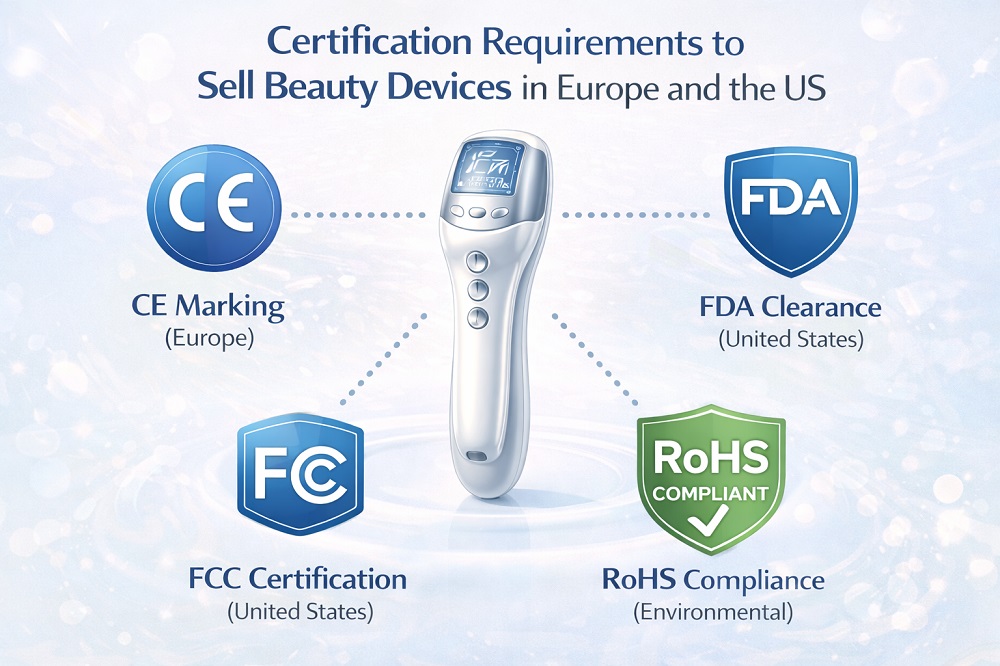
Selling beauty devices in Europe and the United States requires careful attention to regulatory certification requirements. Certifications such as CE marking, FCC compliance, FDA clearance, and RoHS environmental standards play a crucial role in ensuring product safety, quality, and legal market access.
For manufacturers, brands, and distributors in the beauty technology industry, understanding these certification systems is essential when entering international markets.
By meeting these regulatory standards and maintaining high manufacturing quality, companies can build trust with consumers, expand into global markets, and achieve long-term success in the rapidly growing beauty device industry.